

Expert Tree Trimming & Pruning Services
Proper pruning is the single most important thing you can do for your trees. Our ISA Certified Arborists follow ANSI A300 pruning standards to improve tree health, reduce risk, and enhance your property's appearance — without the topping, over-thinning, and hack jobs that damage trees.
Financing available — low monthly payments
Windy-day tree trimming with a spider lift
ANSI A300 pruning from a spider lift on a high-wind day — controlled drops, precision cuts, and complete cleanup.
Types of Tree Pruning We Perform
Every pruning job starts with a clear objective. Our arborists identify what the tree needs — not what is fastest or cheapest — and apply the appropriate pruning type following ANSI A300 standards.
Crown Cleaning
The removal of dead, dying, diseased, crowded, weakly attached, and low-vigor branches from the crown. Crown cleaning is the most common type of pruning and is essential for maintaining tree health and reducing storm damage risk. We target only the branches that need to go, leaving the tree's natural form intact.
Crown Thinning
Selective removal of live branches to reduce crown density, increase light penetration, and improve air movement through the canopy. Thinning is done uniformly throughout the crown — not just the interior — and never removes more than 25% of the live canopy. This reduces wind resistance and the weight on heavy limbs without changing the tree's shape.
Crown Raising
The removal of lower branches to provide clearance for pedestrians, vehicles, buildings, lines of sight, or mowing equipment. Crown raising is common along streets and driveways, over sidewalks, and near structures. We maintain a minimum of two-thirds live crown ratio to ensure the tree stays healthy after raising.
Crown Reduction
Reducing the height or spread of a tree by pruning back leaders and branches to lateral branches that are at least one-third the diameter of the cut stem. Crown reduction is the proper alternative to topping — it reduces size while preserving the tree's natural form and structural integrity. This technique is commonly used when trees have outgrown their space or are interfering with power lines.
Structural Pruning for Young Trees
The best time to develop strong tree structure is when trees are young. Structural pruning — sometimes called training pruning — establishes a single dominant leader, corrects co-dominant stems, removes crossing branches, and spaces scaffold limbs at appropriate intervals.
Trees that are structurally pruned when young rarely need major corrective work as mature trees. A few hundred dollars invested in structural pruning during the first 10 years of a tree's life can prevent thousands of dollars in removal or damage repair decades later.
Our arborists assess branch architecture, identify structural defects, and make targeted cuts that direct the tree's growth into a strong, balanced form. We follow the ISA's best management practices for young tree pruning.
Why Tree Topping Is Never Acceptable
Topping — the indiscriminate cutting of branches to stubs or lateral branches not large enough to assume the terminal role — is the most harmful pruning practice. It is condemned by the ISA, TCIA, and every credible arboricultural organization.
- Produces weakly attached water sprouts that fail more easily than original branches
- Removes up to 100% of leaf-bearing crown, starving the tree of energy
- Creates large wounds that cannot compartmentalize, inviting decay
- Destroys the tree's natural form permanently
- Increases long-term maintenance costs as regrowth must be managed repeatedly
- Reduces property value — topped trees are an eyesore and a liability
When to Prune Wisconsin Tree Species
Timing matters. Pruning at the wrong time can spread disease, cause excessive sap loss, or remove next season's flowers. Here is our species-specific pruning calendar for Southern Wisconsin.
Oak (Red & White)
November through March only. Never prune oaks between April 1 and October 31 to prevent oak wilt transmission via sap beetles.
Maple (Sugar, Silver, Red)
Late summer through late fall is ideal. Pruning maples in late winter or early spring causes heavy sap bleeding — not harmful, but messy and alarming to homeowners.
Apple & Crabapple
Late winter dormancy (February-March) before bud break. Annual pruning promotes fruit production, sun exposure, and disease resistance.
Elm
Late fall through winter dormancy. Avoid pruning from mid-April through mid-July when elm bark beetles are active, reducing Dutch elm disease risk.
Evergreens (Spruce, Pine, Fir)
Light pruning can be done in late spring after new growth (candles) emerges. Dead branch removal is fine year-round. Avoid heavy pruning as conifers do not regenerate from old wood.
Ornamental Flowering Trees
Prune spring-flowering trees (crabapple, magnolia, lilac) immediately after flowering. Summer-flowering trees can be pruned during winter dormancy.
Specialized Pruning Services
Explore our individual trimming and pruning services for more detail on each specialty.
Tree Trimming & Pruning FAQs
Answers to the most common questions about tree pruning standards, timing, and techniques.
What is the difference between tree trimming and tree pruning?▾
In the industry, the terms are often used interchangeably, but pruning is the technically correct term. Pruning refers to the selective removal of specific branches for a defined purpose — health, safety, structure, or aesthetics. Trimming is a broader term that homeowners use to describe shaping or cutting back a tree. At Tree Wise Men, all of our work follows ISA pruning standards, regardless of what you call it.
Why is tree topping harmful?▾
Topping removes large portions of the crown, leaving stubs that cannot heal properly. The tree responds with a burst of weakly attached water sprouts that are more likely to fail than the original branches. Topping also removes the tree's food-producing leaves, starving it and opening wounds to decay. A topped tree is less safe, less healthy, and less attractive than a properly pruned tree. It is never an acceptable pruning practice.
When is the best time to prune trees in Wisconsin?▾
Most deciduous trees are best pruned during dormancy — late fall through early spring — when the tree is not actively growing and diseases like oak wilt cannot spread. Oaks specifically should never be pruned between April and October. Dead or hazardous branches can be removed any time of year. Spring-flowering ornamentals are pruned right after they bloom. Our arborists will advise on the best timing for your specific species.
How often should trees be trimmed?▾
Most mature shade trees benefit from pruning every 3 to 5 years. Younger trees should be structurally pruned every 2 to 3 years to develop strong branch architecture early. Fast-growing species like silver maple or willow may need more frequent attention. Fruit trees are typically pruned annually during winter dormancy.
Will pruning hurt my tree?▾
Proper pruning does not hurt a healthy tree. Trees compartmentalize wounds — they wall off pruning cuts and continue growing. The key is making correct cuts at the branch collar, never removing more than 25% of the live canopy at once, and avoiding flush cuts or stub cuts. Improper pruning — topping, lion-tailing, or over-thinning — does hurt trees. That is why hiring an ISA Certified Arborist matters.
Do you follow ANSI A300 pruning standards?▾
Yes. All of our pruning work follows the ANSI A300 standards, which are the accepted industry standards for tree care in the United States. These standards define proper pruning objectives, cut types, and limits on canopy removal. Following A300 standards means your trees get science-based care — not guesswork.
From Our Blog
How Tree Trimming Benefit Property in Janesville
Read more
THE IMPORTANCE OF PROFESSIONAL TREE MAINTENANCE: A GUIDE TO CUTTING, TRIMMING, AND PRUNING
Read more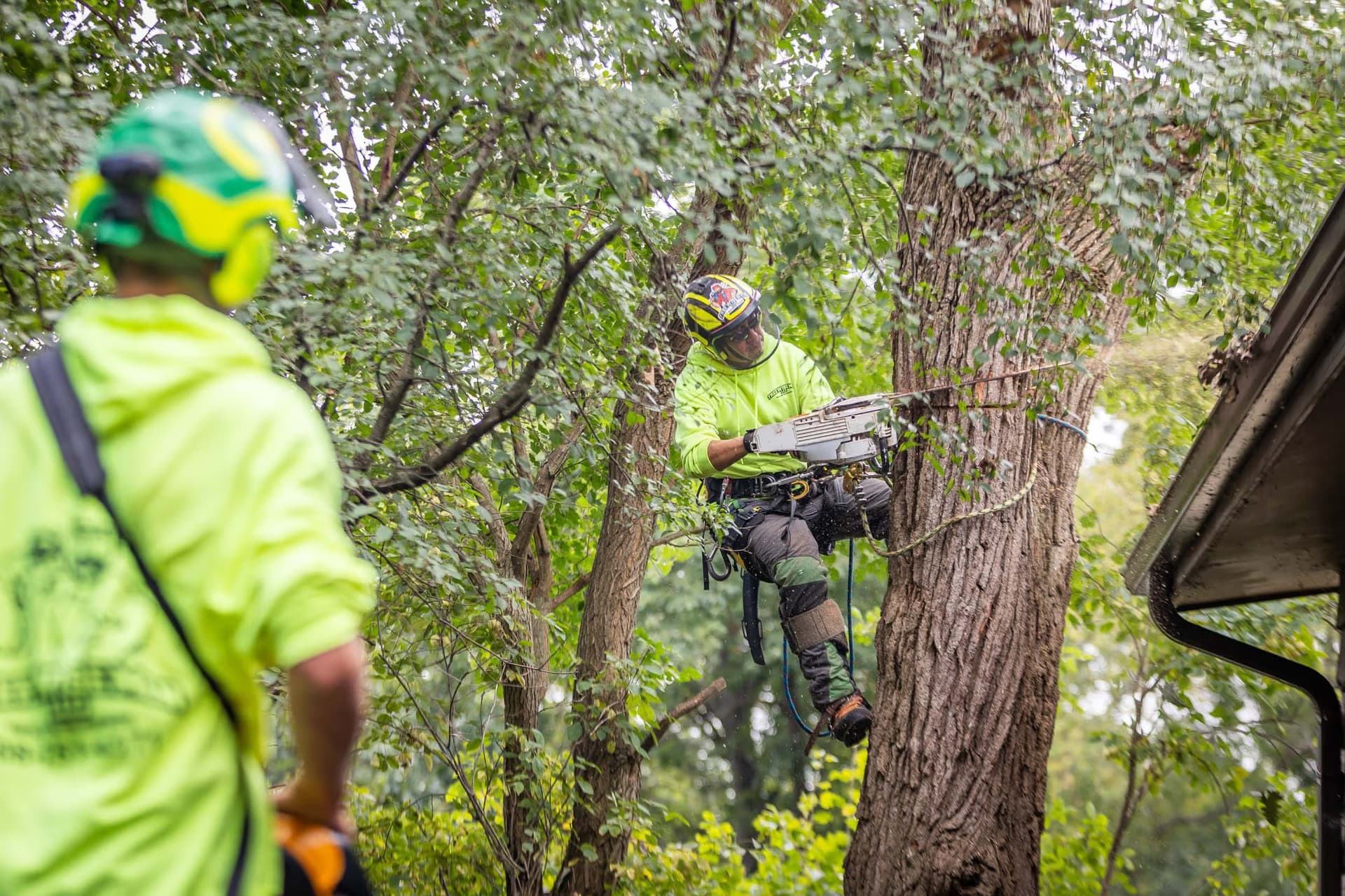
Understanding Property Lines: Whose Responsibility is Tree Care, Trimming, or Removal?
Read more
Is it Cheaper to Trim a Tree or Cut it Down in Janesville, WI
Read more


Related Tree Trimming Guides
Pruning timing, technique, cost, and species-specific approaches — the deeper guides on every part of professional tree trimming in Southern Wisconsin.
Tree Trimming in Janesville
Local timing, oak wilt windows, and ANSI A300 pruning in Rock County.
Tree Trimming in Madison
Estate trees, Madison Forestry coordination, and Dane County timing.
Benefits of Tree Trimming
Why proper pruning matters for tree health and property value.
Trim or Remove?
Cost comparison and decision framework for borderline trees.
Pruning Guide
Crown cleaning, thinning, raising, and structural pruning explained.
Fruit Tree Pruning
Apple, pear, cherry, plum — annual pruning for fruit production.
Crown Reduction
Proper canopy reduction vs. topping — what each does to your tree.
Seasonal Care Calendar
When to prune what, by Wisconsin month and species.
Schedule Professional Tree Pruning
Stop guessing and start pruning with purpose. Our ISA Certified Arborists will assess your trees and recommend a pruning plan tailored to each species, age, and condition.